
Learn Japanese Online for Free: What's Free in November 2026

You can learn Japanese online free up to about A2 level. The Japan Foundation's Minato site runs free self-study courses, NHK's Easy Japanese has 48 ten-minute lessons with free audio and PDFs, and Irodori is a full textbook you can download. Speaking practice with a teacher is where you start paying.
On this page
What we checked
- JF Minato, NHK WORLD-JAPAN Easy Japanese, Irodori, and Mango Languages: the public pages and course details on 11/11/2026.
- Italki and Preply: the Japanese tutor search pages on 11/11/2026. No lesson was booked.
- LingQ and Glossika: plan prices in the US App Store and on the Glossika pricing page on 11/11/2026. Nothing was paid.
Key takeaways
- JF Minato, run by the Japan Foundation, listed 95 courses, and its self-study courses from A1 to B1 carried no fee (minato-jf.jp, ).
- NHK's Easy Japanese has 48 lessons of 10 minutes each, and the MP3 audio and PDF textbook are free for personal use (nhk.or.jp, ).
- Irodori, a Japan Foundation textbook from A1 to B1, downloads as PDF and MP3 files with no account or checkout step (irodori.jpf.go.jp, ).
- Free ends at speaking with a teacher: a trial lesson with a Japanese tutor on italki had a median price of $10 (italki.com, ).
Step 1: Take a free Japanese course at JF Minato
If you want one place to learn Japanese online free with a clear path, start with JF Japanese e‑Learning Minato. The Japan Foundation runs it, and on it listed 95 courses: self-study, tutor-supported, and courses for teachers. The self-study ones from A1 to B1 were marked free. You sign up for a Minato account, then register for each course.
Two good first courses, both in English:
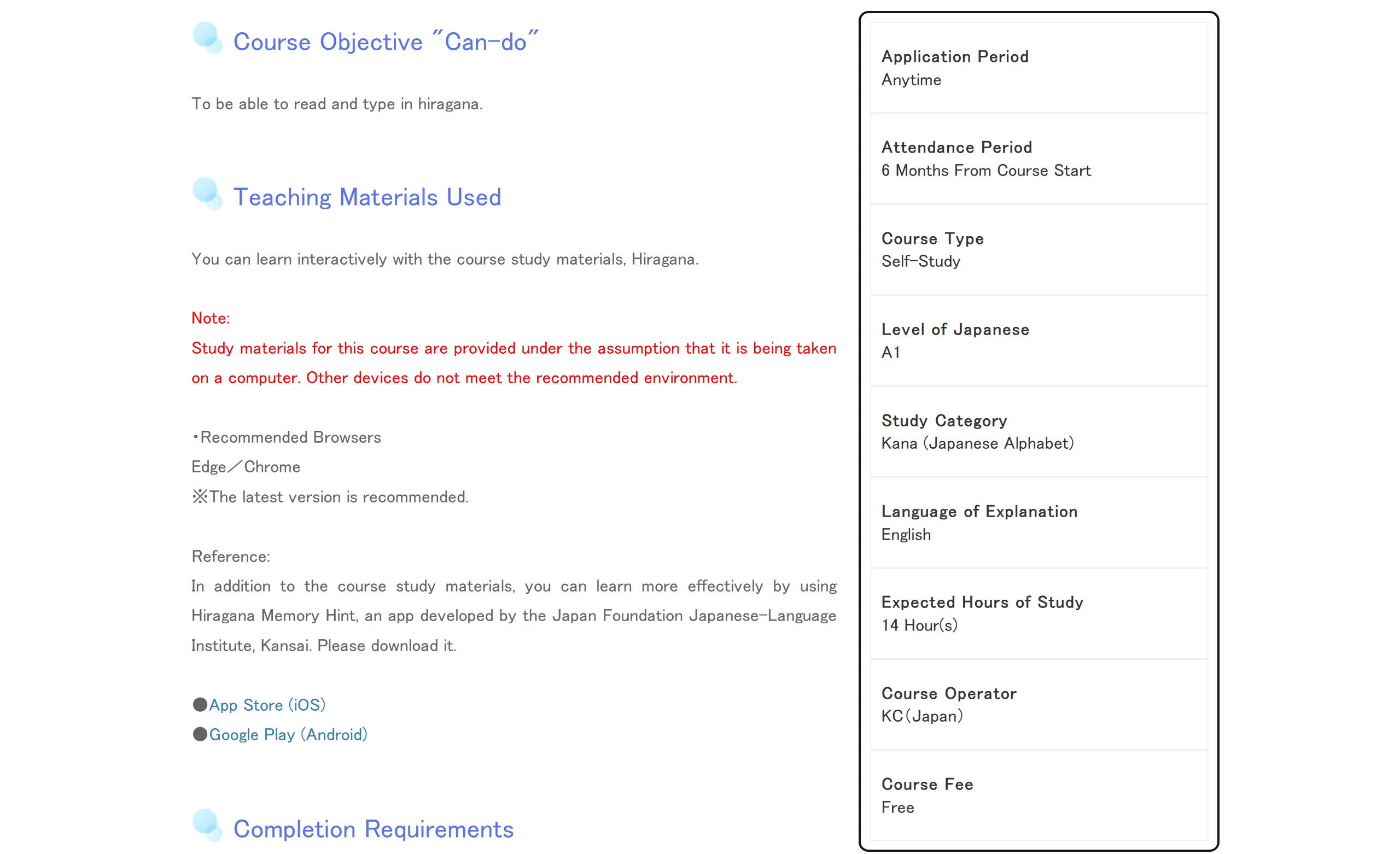
- Hiragana A1 Self-Study Course. You learn to read and type hiragana with interactive drills, in about 14 hours of study, and you have 6 months to finish (minato-jf.jp, ).
- Marugoto A1-1 (Katsudoo) Self-Study Course. It focuses on listening and speaking in everyday situations: greetings, your family, the food you like, and what time you get up. Minato expects about 24 hours of study.
Minato says the hiragana materials assume you are on a computer, and other devices don't meet its recommended setup. For phone practice, the same page points to Hiragana Memory Hint, a free app from the Japan Foundation.
- Best for: beginners who want a set order of lessons
- Skip if: you mostly study on a phone
Step 2: Add free Japanese lessons for beginners from NHK
NHK WORLD-JAPAN, Japan's public broadcaster, runs Easy Japanese: 48 lessons of 10 minutes each that meet the JF Standard at A1 to A2. The course follows a student who comes to Japan, so you hear the phrases in context: asking for directions, saying where you are from, asking someone to speak more slowly.
Every lesson has an MP3 file and a PDF, and NHK says both can be downloaded free of charge for personal use. You can also grab all 48 lessons as one 18 MB PDF, plus a hiragana and katakana chart (nhk.or.jp, ). No account is needed.
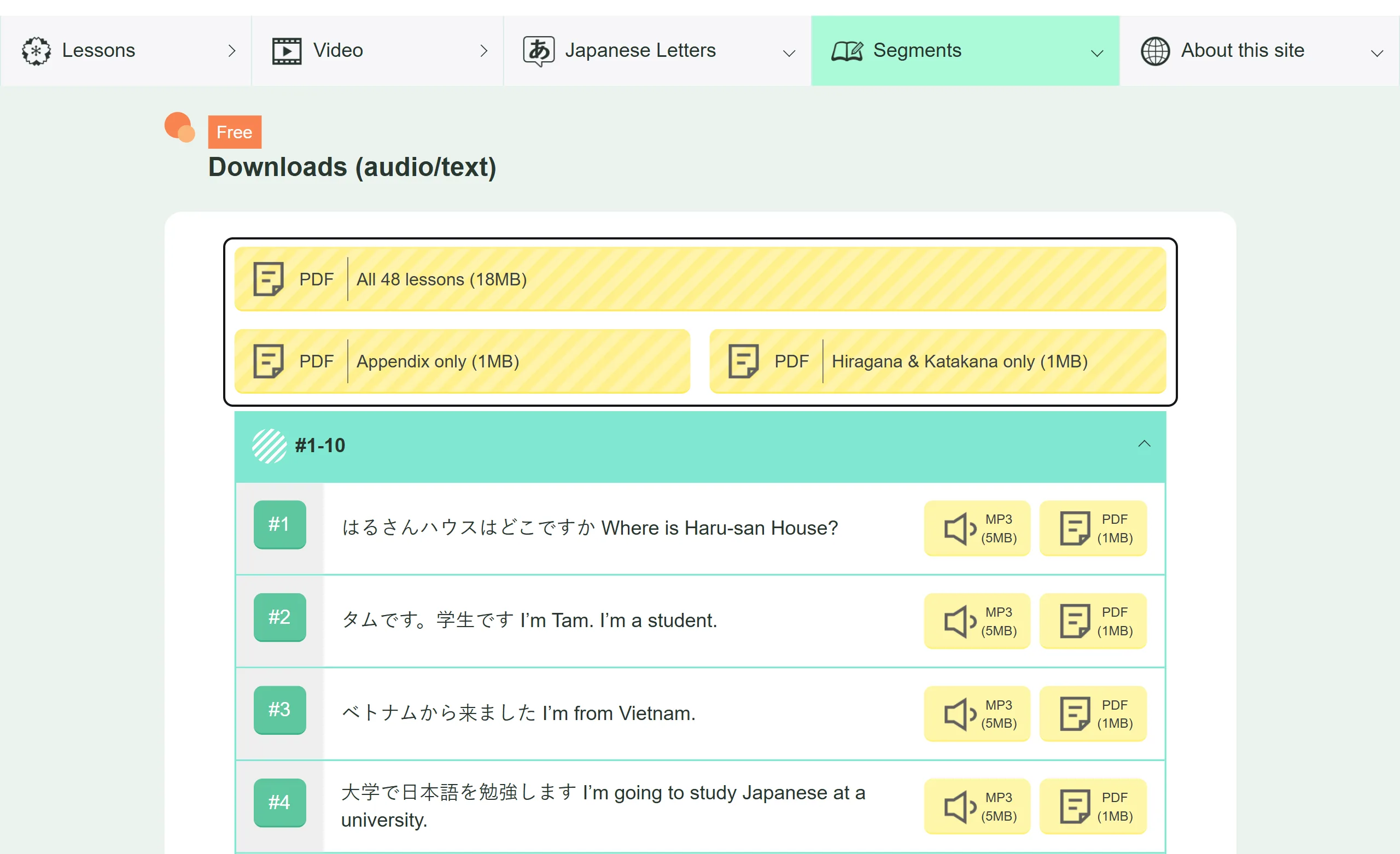
The same NHK page lists Easy Japanese grammar lessons, Easy Travel Japanese for short trip phrases, and Easy Japanese for Work at the elementary and intermediate levels. Listen once with the text, then again without it, and repeat each line out loud.
Step 3: Download the Irodori textbook
Irodori is the Japan Foundation's textbook for everyday Japanese, in four books: Starter at A1, Elementary 1 and 2 at A2, and Pre-Intermediate at A2 to B1 (irodori.jpf.go.jp, ). The books come as PDF files, and the audio can be downloaded or streamed. The site says you can download it "from wherever you are in the world".
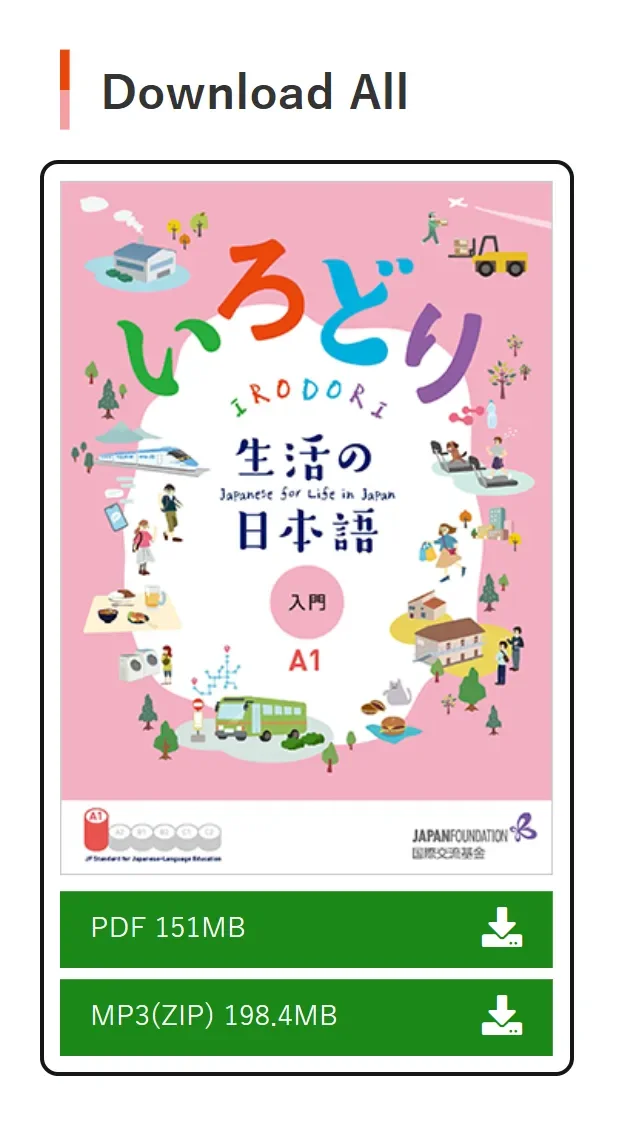
On , the Starter page offered the whole book as a 151 MB PDF and the audio as a 198.4 MB ZIP, with no sign-up or payment step. The FAQ says schools that print it may charge only for printing and binding, not profit from it.
Irodori was written for people living in Japan or planning to move there. If you study for travel or anime, its FAQ says you can still pick the topics that fit you and skip the rest.
Step 4: Check your library card
Many U.S. public libraries pay for language apps so cardholders don't have to. Mango Languages sells access to libraries and lists 70+ languages for patrons with a library card (mangolanguages.com, ), and Japanese is on its language list. Search your library's website for "Mango" or "language learning", or ask at the desk.
A library app works well next to the free courses above: a few minutes of vocabulary and listening review a day, without a subscription.
Step 5: Find speaking practice
Free routes stop at speaking. Courses and textbooks can't hear your pronunciation or keep a conversation going, and free Japanese language classes online with a live teacher are hard to find, though paid live Japanese classes online exist. You have two ways forward.
The free one is a language exchange. You meet a native Japanese speaker who is learning English, and you split the time between the two languages. It costs nothing, but your partner is not a trained teacher.
The paid one is a tutor, and a cheap trial lesson is the safest test. On italki, which listed 1,217 Japanese tutors, trial lessons on the first results page ran from $5 to $29, with a median of $10. The site says a 30‑minute Japanese lesson typically costs $3 to $10 (italki.com, ). Preply listed 5,449 Japanese tutors, and its trial lesson of 25 or 50 minutes is paid (preply.com, ).
When free isn't enough
A free Japanese tutor online every week is rare (see where to book Japanese private lessons), and the free courses run out past A2. From there, you pay for a plan or for each lesson, or compare the best apps to learn Japanese. Here is what each option costs at the start and how you leave.
| Brand | What's free | Paid from | Cancel online |
|---|---|---|---|
| LingQ | Free plan: 20 saved words | $10 a month billed yearly ($119.99) | Yes, in Settings |
| Glossika | 7‑day trial, no card | $16.58 a month billed yearly | Yes, any time |
| Italki | Trials from $5 | Median $10 per trial lesson | No plan, cancel a lesson 24 hours ahead |
| Preply | Paid trial lesson | Median $39.50 per 50‑minute lesson | Yes, in Settings |
Prices verified in the US App Store (LingQ) and on ai.glossika.com, italki.com, and preply.com. Tutor medians are from the first results page for Japanese. LingQ's free-plan limits were checked in a free account on . Plan prices are before tax, plus sales tax that varies by state. We did not verify tutors' credentials ourselves.
LingQ refunds a first Premium sign-up within 30 days, and other payments are not refunded (lingq.com terms, checked ). Glossika's monthly payments are final. For a ranked list of paid Japanese courses, see Japanese courses online, or read our LingQ review, italki review, and Preply review.
Common questions
Can I learn Japanese online for free?
Yes, through the beginner levels. The Japan Foundation's Minato site, NHK's Easy Japanese, and the Irodori textbook together cover A1 and A2 on the JF Standard, which uses the same six levels as the CEFR. What you can't get free is a teacher who listens to you every week. Plan on paying for speaking practice once you can hold a short conversation.
What is the best free Japanese course?
For a structured start, JF Minato. It is run by the Japan Foundation, and its self-study courses from A1 to B1 had no fee on (minato-jf.jp). Begin with Hiragana A1, about 14 hours, then Marugoto A1-1. If you prefer short audio lessons, NHK's Easy Japanese is the best free Japanese course for listening, with 48 lessons of 10 minutes each.
Can I get a Japanese tutor online for free?
Not from the big tutor sites. On italki, trial lessons with Japanese tutors on the first results page ran from $5 to $29, with a median of $10 (italki.com, ). Preply's trial is paid too. The free option is a language exchange: you practice Japanese with a native speaker and help them with English in return.
What do N5 to N1 mean in Japanese?
They are the five levels of the Japanese-Language Proficiency Test (JLPT). N5 is the easiest and N1 the hardest (jlpt.jp, ). The free courses on this page stop around A2 on the JF Standard, which roughly lines up with the N5 and N4 range. The test itself is not free, and you take it in person at a test center.
Do I need to learn hiragana first?
Yes, and it takes less time than most beginners expect. Minato estimates about 14 hours for its Hiragana A1 course (minato-jf.jp, ), and NHK's Easy Japanese includes a hiragana and katakana chart as a separate 1 MB PDF. After that, textbooks such as Irodori become much easier to read, because kana replaces most of the romaji. Kanji come later and take much longer.