
Babbel vs Duolingo in 2026: Price, Free Plan, Teaching

In Babbel vs Duolingo, Babbel comes out ahead 8.3 to 6.5 out of 10, mostly on teaching: its lessons explain the grammar as you go, and its Spanish course goes further. Duolingo is the better pick if you won't pay: every Duolingo lesson is free, while Babbel stops after the first one.
Quick comparison
| Compared | Babbel | Duolingo |
|---|---|---|
| Grade | 8.3/10 | 6.5/10 |
| Price | $8.95/mo on the annual plan · verified | $9.99/mo on the annual plan · verified |
| Free lessons | Lesson 1 of each course | Every lesson, with ads |
| Free trial | None | 30 days on the web |
| Languages | 13 | 40 |
| Refunds | 14-day money-back at checkout | Nonrefundable per Terms |
| Grammar notes | Inside lessons | In a unit Guidebook |
| Best for | Grammar-first lessons in Spanish, French, German or Italian | A free daily habit in 40 languages, ads included |
| Skip it if | You want Japanese, Korean or Chinese, or a free plan beyond lesson one | You need grammar explained or speaking drills on web |
Read review |
On this page
- Quick comparison
- Babbel vs Duolingo: free daily habit or paid course
- Price and free plan: Duolingo is free, Babbel is cheaper per year
- Teaching quality: grammar explanations inside Babbel lessons
- Features: Babbel has more of what a course needs
- Ease of use: Duolingo is quicker to start
- Refunds and cancellation: read both before you pay
- Languages offered, and Babbel vs Duolingo for Spanish
- Who each app fits
What we checked
- Babbel: sign-up, Lesson 1 of Spanish (Latin America), the paywall at Lesson 2, US prices, and checkout up to the Subscribe button on 11/10/2026. Nothing was paid.
- Duolingo: a Spanish lesson, the hearts limit, the Super plans, and checkout up to the trial button on 11/11/2026, plus the Unit 1 Guidebook. Nothing was paid.
- Both: terms, refund and cancellation rules, account deletion, and app store ratings. Speaking exercises in the phone apps were not checked.
Babbel vs Duolingo: free daily habit or paid course
Both are language learning apps built on bite-sized lessons, and both open Spanish with greetings and café words. The difference is what you pay and what you get explained. Duolingo gives away every lesson and asks for money to remove ads and the hearts limit. Babbel gives away one lesson per course and asks for money for the rest.
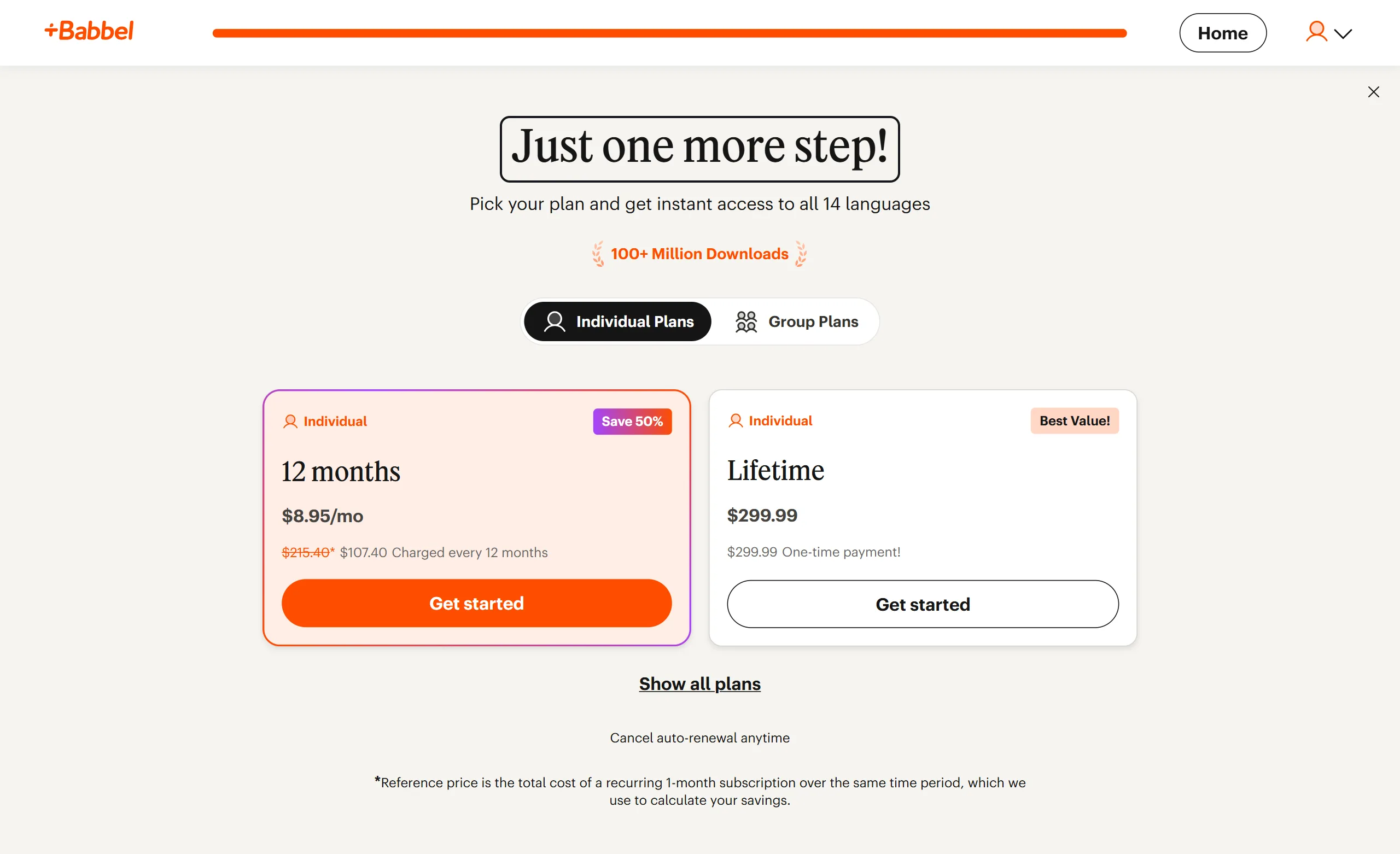
We set up a free account on each in the US: Babbel on , Duolingo on . On Babbel, Lesson 1 of Spanish (Latin America) was free. Tapping Lesson 2 opened a plan picker that said "Just one more step! Pick your plan and get instant access to all 14 languages."
On Duolingo, the first lesson opened before we'd even made an account. After that, the free account kept going: the limit is 5 hearts, and a wrong answer costs one. When we ran out, Duolingo offered a free refill, twice in the same lesson.
So is Babbel better than Duolingo? On our grading method, yes overall: Babbel scores 8.3 out of 10 and Duolingo 6.5. Babbel wins three of the six axes, Duolingo wins two, and language coverage is a tie. Babbel's lead comes from the heaviest axis it wins, teaching quality.
| Axis | Weight | Babbel | Duolingo |
|---|---|---|---|
| Teaching quality | 30% | 9.5 (Excellent) | 4 (Fair) |
| Price & free plan | 20% | 7 (Good) | 9.5 (Excellent) |
| Features | 15% | 9 of 10 | 4 of 10 |
| Ease of use | 15% | 7 (Good) | 9.5 (Excellent) |
| Trust | 10% | 7 (Good) | 4 (Fair) |
| Language coverage | 10% | 9.5 (Excellent) | 9.5 (Excellent) |
The full write-ups are in our Babbel review and Duolingo review. The sections below compare the two apps axis by axis.
Price and free plan: Duolingo is free, Babbel is cheaper per year
Duolingo scores 9.5 here and Babbel 7. Duolingo's free version has every lesson, with ads. Babbel has no free trial and no free plan beyond Lesson 1 of each course, which keeps it a grade lower despite the lower annual price.
| Plan | Babbel | Duolingo Super |
|---|---|---|
| Free | Lesson 1 of each course | Every lesson, with ads and 5 hearts |
| 1 month | $17.95 | $16.99, billed right away |
| 12 months | $107.40, or $8.95 a month | $119.99, or $9.99 a month |
| Lifetime | $299.99 once | No lifetime plan |
| Up to 6 people | $185.70 a year (group plan) | $143.99 a year (Family) |
| Trial | None | 30 days free on the annual web plan |
If you'll pay for a full year, Babbel's annual plan was $12.59 cheaper than Duolingo Super's (prices checked and ). Month to month, it's the other way around: $17.95 for Babbel against $16.99 for Super. For a household, Duolingo Family is cheaper than Babbel's group plan. None of these prices include sales tax, which depends on your state, and Babbel's checkout showed no tax line. And Duolingo is the only one where $0 is a real option, because the paid subscription changes how you study, not what you can study.
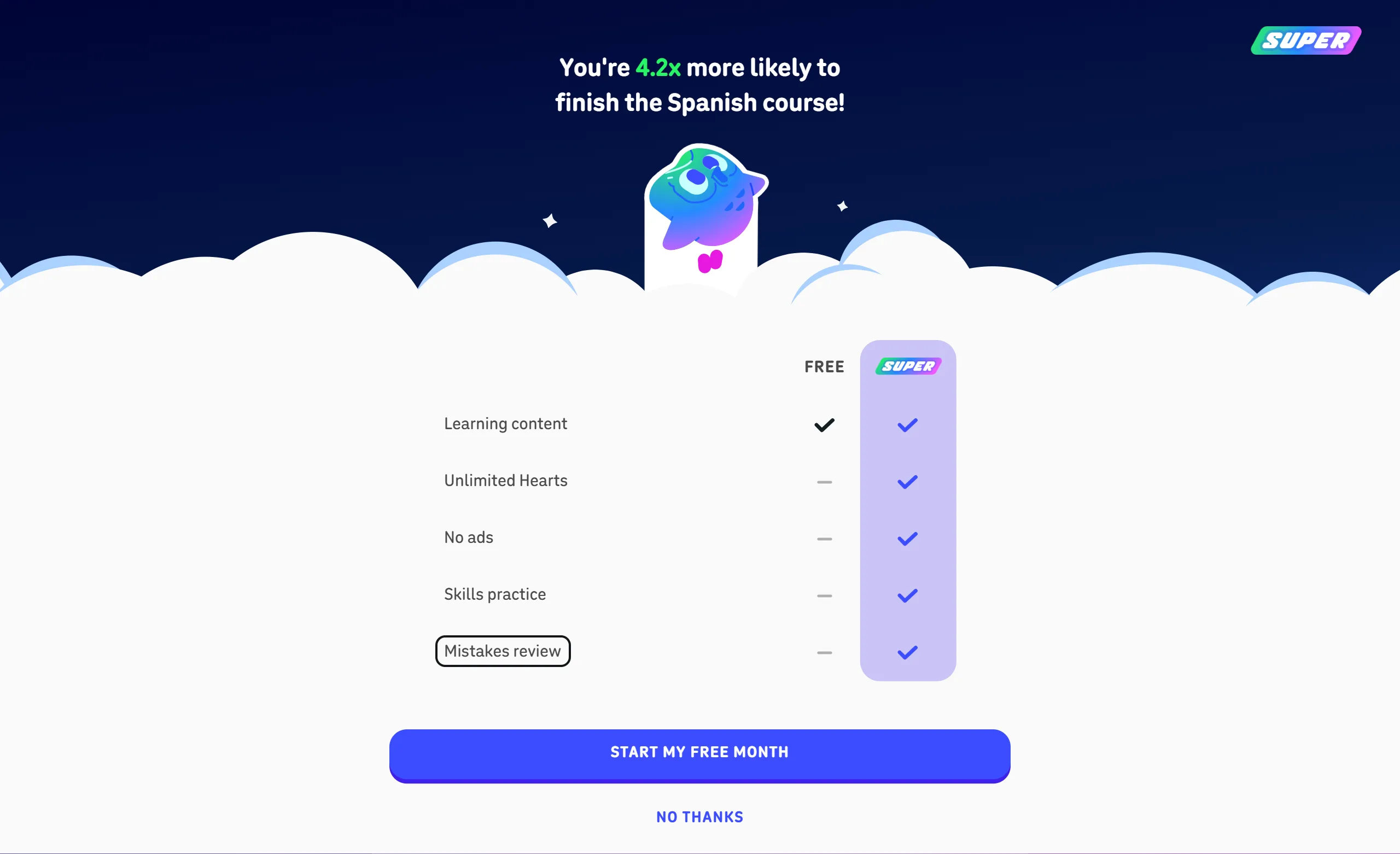
That's how the Super offer frames it, too. Learning content is free, and Super adds unlimited hearts, no ads, skills practice, and mistakes review (). The same screen claims "You're 4.2x more likely to finish the Spanish course!" with Super, which is Duolingo's figure, not ours.
Watch where you buy. In the App Store on 11/10–, Duolingo advertises a 14-day free trial, against 30 days on the web, and Babbel's 12-month all-languages plan costs $107.99 against $107.40 on its site. More detail is in our Babbel price breakdown and our page on what Babbel gives away for free. For Super's plans, trial, and refunds, see what Duolingo costs.
Teaching quality: grammar explanations inside Babbel lessons
Babbel gets 9.5 (Excellent) for teaching and Duolingo 4 (Fair). Babbel's structured lessons explain things as you go, and Duolingo's lessons mostly have you match words and pick answers. For a method that teaches with pictures and no English, compare Babbel vs Rosetta Stone.
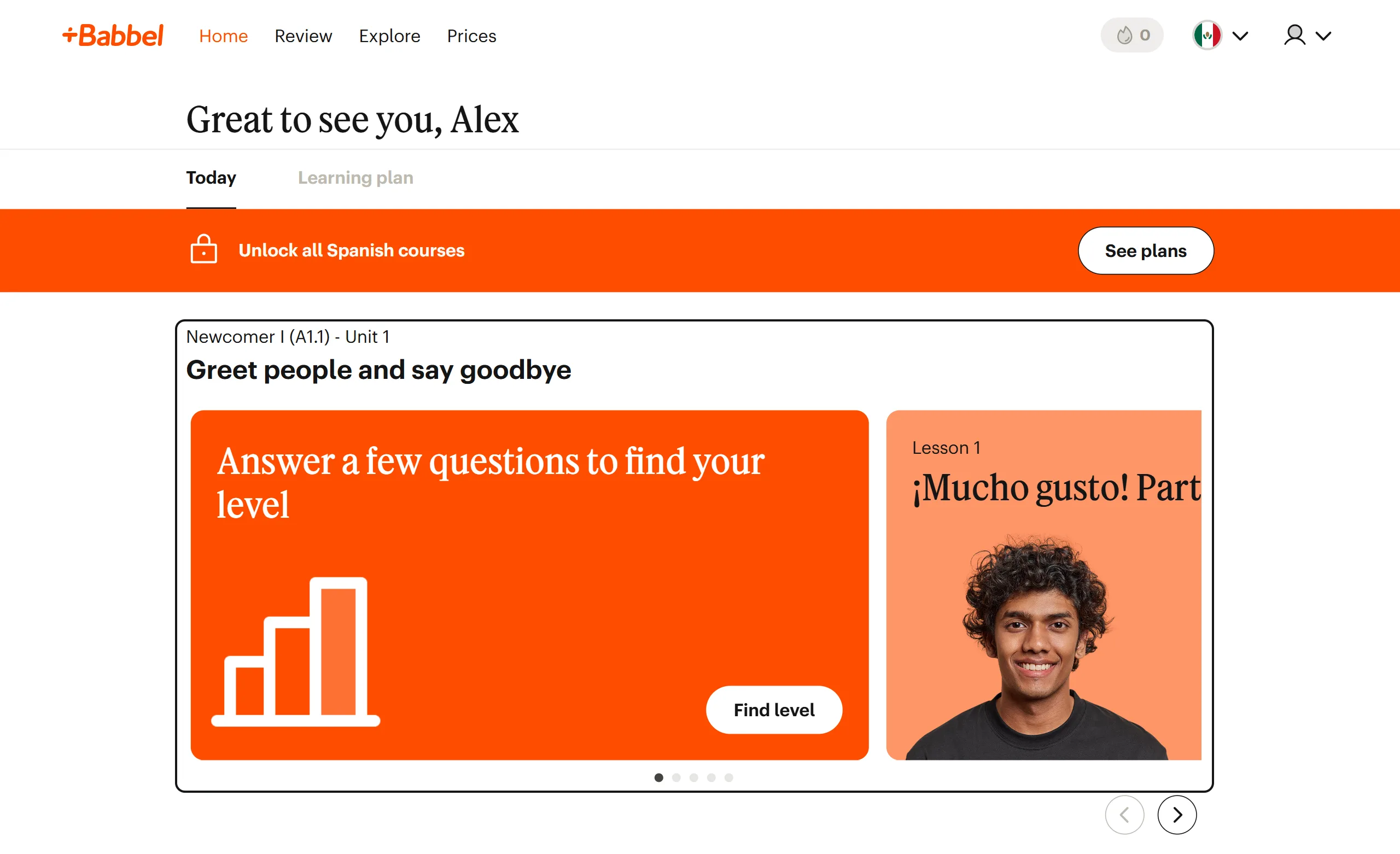
Babbel's first Spanish lesson, "¡Mucho gusto! Part 1," ran through seven exercise types: guessing a word from a photo, picking the phrase you hear, matching, filling gaps in a short dialogue, building a phrase, listening, and choosing what you'd say to a coworker in a real-life conversation. A tip popped up mid-lesson: "The h in hola is silent." The lesson ended with a score of 21 of 23 answered correctly.
Duolingo's Spanish lesson was picture choice (libro, perro, agua), matching pairs, translating with a word bank, and picking the right meaning. A wrong answer showed the correct solution and took a heart, and at the end the app went back over the exercises we'd missed. There were no grammar notes inside the lesson.
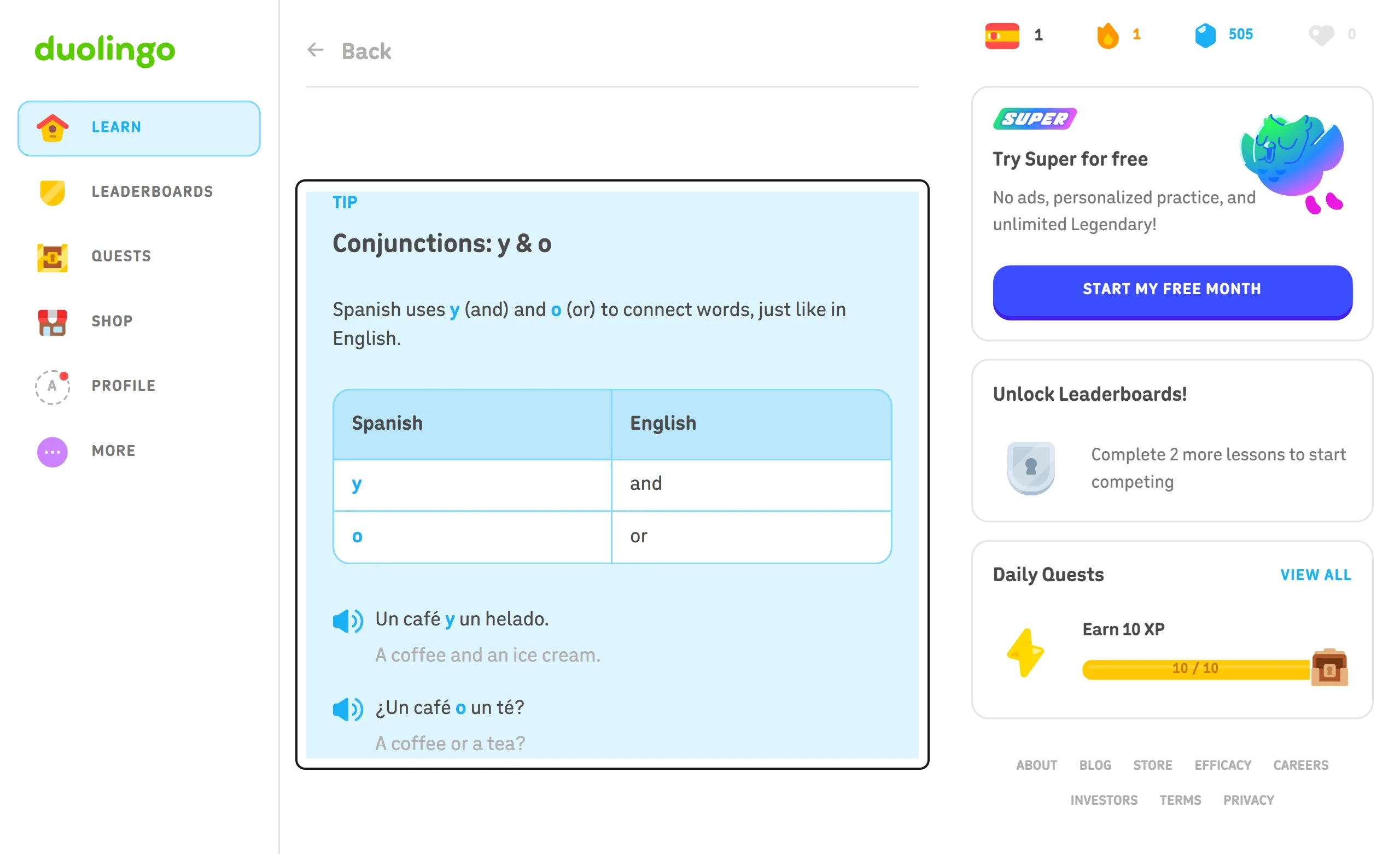
Duolingo does explain grammar, just somewhere else. Each unit has a Guidebook on the web with key phrases and tips. On , Unit 1's Guidebook had a short tip on "y" and "o," the words for "and" and "or." You have to open it yourself, though, from the button at the top of the unit.
Neither app gave us speaking practice on the web. No speech exercise came up in either first lesson. Babbel's help center says speech recognition works in its app and in Chrome, and Duolingo's says the phone app has speaking and pronunciation practice. We haven't checked either in the phone apps, so they aren't part of the scores.
Features: Babbel has more of what a course needs
Babbel scores 9 of 10 on our features checklist and Duolingo 4. Items we couldn't confirm count as missing, which hurts Duolingo more.
Babbel's help center documents a placement quiz for Spanish, French, Italian, and German, speech recognition with pronunciation practice, offline lessons in the app, spaced-repetition review, progress sync between web and app, courses that reach B2 or higher, and a certificate for each finished course (). It also has Babbel Speak, an AI conversation partner, in beta and only in the phone app. The missing item is live classes: the US price list on had no plan with them.
Duolingo's four confirmed items are choosing your starting level ("Jump here?" on later units), an AI conversation in the Max plan, review of your mistakes, and a Spanish course labeled up to B2. Max is sold only in the iOS and Android apps, per Duolingo's help center (), and its website didn't show a price.
Ease of use: Duolingo is quicker to start
Duolingo gets 9.5 and Babbel 7. Duolingo's first lesson opens before sign-up. Babbel asks its questions first: the sign-up form came on screen 12 of its onboarding, after 9 questions about goals and level ().
Both apps are well rated, but Duolingo has far more ratings: 4.7 from 5,581,657 in the App Store and 4.7 from 51.8 million reviews on Google Play (). Babbel had 4.7 from 757K in the App Store and 4.6 from 1.13 million reviews on Google Play.
Duolingo's streak, sounds, and hearts make lessons feel like a game. That gamification is a big part of why it's easy to open every day. Babbel's lessons, 10 to 15 minutes each per its help center, are built for a slot in a busy schedule rather than a streak. On both, you go at your own pace.
Refunds and cancellation: read both before you pay
Babbel gets 7 (Good) for trust and Duolingo 4 (Fair). Babbel offers a 14-day money-back window at checkout, though its refund rules contradict each other. Duolingo's are simple: no refunds.
Babbel's US checkout said, on : "14-day money-back guarantee Just write to Customer Service within 14 days of your initial purchase for a full refund." Its US Terms (July 2026) say Babbel is "not obligated to provide you with a pro-rata refund" and that the 14-day withdrawal clause doesn't apply. To stop a renewal, the help center says you can cancel "up to the day before the renewal date," but the Terms ask for 48 hours' notice. Plan on 48 hours.
Duolingo's Terms (revised ) start with "All payments are nonrefundable." They rule out credit for a partly used membership period too, unless the law where you live requires it. Web subscribers can email support and ask. App Store and Google Play purchases go through Apple or Google. The free trial must be canceled at least 24 hours before it ends.
Deleting your account works differently too. On Babbel, deleting the account cancels a babbel.com subscription as of the next possible cancellation date (). On Duolingo, erasing your data in its Data Vault does not cancel Super (). On both, a subscription bought in an app store has to be canceled there.
Languages offered, and Babbel vs Duolingo for Spanish
Both score 9.5 for coverage, but the lists differ. Duolingo teaches 40 languages to English speakers, including Japanese, Korean, and Chinese. Babbel's help center lists 13, none of them East Asian, even though its plan picker says 14.
Depth runs the other way, and it matters more for intermediate learners. For Babbel vs Duolingo in Spanish, Babbel's Spain Spanish courses go up to C1 and its French, German, and Italian courses to B2, while Latin American Spanish stops at B1 (help center, ). Duolingo's Spanish learning path has 8 sections, and it labels the last two B2 (). That's the app's own label, not a test result.
Spanish is the biggest course on Duolingo, with 41.9 million learners shown on its course picker (). For more options in that language, see our list of the best apps to learn Spanish or the full list of best language learning apps.
Who each app fits
Is Babbel or Duolingo better for you? It depends on your learning style: whether you'll pay, and how much you want the grammar explained. Many people start on Duolingo's free plan and move to Babbel, or one of the other Duolingo alternatives, once they want the rules behind the phrases. For a third app, see Busuu vs Duolingo; for lessons with no English at all, see Rosetta Stone vs Duolingo.
Babbel
- Best for: grammar explained inside each lesson
- Best for: a year paid up front at $8.95 a month
- Skip if: you won't pay after Lesson 1
Duolingo
- Best for: a free daily habit in 40 languages
- Best for: Japanese, Korean, or Chinese
- Skip if: you want refunds or in-lesson grammar notes
Common questions
Is Babbel or Duolingo better for Spanish?
For Spanish, Babbel goes further and explains more. Its Spain Spanish course runs to C1 and Latin American Spanish to B1, per its help center (), and grammar tips appear inside lessons. Duolingo's Spanish course is free and labels its last two sections B2 (). Start free on Duolingo, then pay for Babbel when you want the rules spelled out.
What do Reddit users say about Babbel vs Duolingo?
There's no tally to report. Threads in r/languagelearning, r/babbel, and r/duolingo rank for this search, and the top Babbel thread is titled "Babbel is way better than duolingo!" (Google US, ). That's a Babbel fan forum, so read it as one side. Reddit blocked our reader, so we haven't summarized the replies.
Can you become fluent with Babbel or Duolingo?
Neither app claims to get you there alone. Babbel's longest course, Spain Spanish, stops at C1, and its course certificates are "not formally recognised" (help center, ). Duolingo's Spanish course tops out at sections it labels B2. Both apps rely on you adding conversation practice with native speakers.
Why are people ditching Duolingo?
We can only point to what's on record. On Trustpilot, Duolingo has 1.5 stars from 8,263 reviews, and recent ones complain about a trial charged a day early and a refund refused (). Its Terms say all payments are nonrefundable. The app itself is rated 4.7 in both app stores.
Is Babbel worth paying for if Duolingo is free?
It is if you want grammar explained inside each lesson and a course that goes past B2 in Spanish. Babbel's annual plan was $107.40, or $8.95 a month, on , and there's no free trial, only Lesson 1 of each course. If a free daily habit is the goal, Duolingo covers it. If you'd rather learn by listening, see Babbel vs Pimsleur.